Quick answer
If your work is limited to mild steel and stainless steel, a DC TIG power source such as a suitable Miller Maxstar model may cover the process without paying for AC capability that is not required. If aluminium is part of the workload, start with an AC/DC TIG family such as Miller Dynasty or Syncrowave. The final choice should then be narrowed by material thickness, required amperage, duty cycle, available input power, portability, process controls, cooling and the complete torch-and-accessory package.
This guide is intended to help Malaysian fabrication and maintenance teams prepare a useful equipment enquiry. It does not replace a qualified application review, an approved welding procedure specification or the model-specific Miller documentation.
Start with the material: DC or AC/DC TIG
Material is the fastest way to divide the available options. Miller's TIG guidance states that DC-only TIG is sufficient for steel and stainless steel. Aluminium requires AC TIG because the alternating-current cycle provides the cleaning action needed to address the aluminium oxide layer while welding.
For a workshop that only fabricates stainless-steel tanks, frames, pipework or components, a DC TIG/Stick machine can be the more focused choice. For a mixed-material operation that handles stainless steel today and aluminium tomorrow, an AC/DC machine provides the necessary process flexibility.
Do not decide from the brand name or maximum amperage alone. Confirm every material and thickness the team expects to weld during the equipment's service life.
Comparing the main Miller TIG families
Miller Maxstar: focused DC TIG and Stick capability
The Miller Maxstar family consists of DC TIG/Stick power sources. It is relevant when the work centres on mild steel, stainless steel and other materials suited to DC TIG, and when portability or compact setup matters. Different Maxstar models cover different output ranges, so the model must be matched to the thickest regular workpiece, expected arc-on time and site input power.
Maxstar is not the route for conventional AC TIG welding of aluminium. If aluminium is a genuine production requirement, move the selection discussion to an AC/DC family instead of trying to solve the limitation through accessories.
Miller Dynasty: AC/DC control for mixed and demanding TIG work
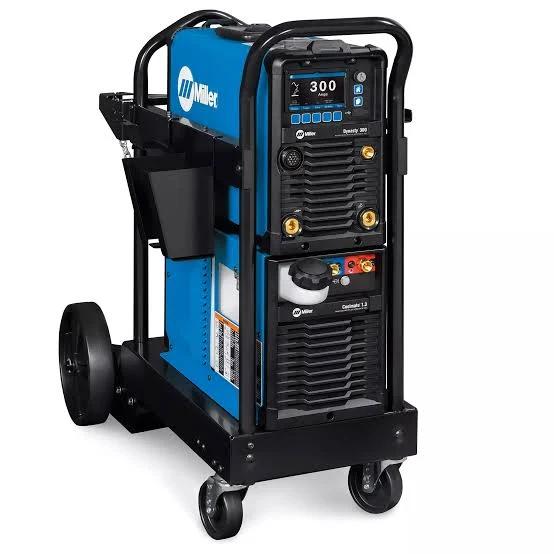
The Miller Dynasty family provides AC/DC TIG and Stick capability. It is the natural Miller route when aluminium must be welded alongside steel or stainless steel, or when the application benefits from more control over TIG parameters and repeatable setup.
Current Dynasty models span multiple output classes. The appropriate size depends on material thickness, joint design, production demand and whether the machine must support advanced procedures or saved programs. More available settings are useful only when they solve an application or quality requirement, so buyers should define the required controls before choosing a model tier.
Miller Syncrowave: accessible AC/DC TIG for workshop applications
The Miller Syncrowave family also provides AC/DC TIG capability for aluminium, stainless steel and steel. Miller positions current Syncrowave systems around straightforward setup, productive TIG operation and shop-oriented applications. It can be a practical route where the team needs AC/DC material flexibility with an interface intended to simplify parameter selection.
Compare the exact Syncrowave package, input requirement, cooling arrangement and included accessories rather than assuming every package is configured the same way.
Seven questions to answer before requesting a quotation
- Which materials will be welded: mild steel, stainless steel, aluminium or a combination?
- What are the normal and maximum material thicknesses, joint types and weld positions?
- What input voltage and phase are available where the machine will actually operate?
- What amperage range, duty cycle and daily production volume are expected?
- Will the system remain in one bay, move around a workshop or travel to site?
- Is an air-cooled torch sufficient, or does the amperage and arc-on time justify a water-cooled setup?
- Which controls, programs, documentation, training and post-sales services are required by the operation?
These answers help separate a suitable system from a machine that merely looks adequate on a catalogue page.
Match the power source to the complete TIG system
A TIG purchase is not only the blue power source. A working configuration can include the TIG torch, electrode holder, work lead, foot pedal or fingertip control, gas regulator and hose, tungsten, filler metal, cooler, running gear and suitable electrical connection.
Torch cooling deserves particular attention. Air-cooled torches are simpler and easier to move, while water-cooled systems can improve operator comfort during higher-amperage or longer-duration work. The correct choice depends on the actual load and working pattern, not only the maximum output printed on the machine.
Confirm compatibility and package contents for the selected model. A low initial quotation can become misleading if essential controls, cooling or connection items are excluded.
Practical selection scenarios
Stainless-steel fabrication without aluminium
Start by reviewing the Maxstar range. Confirm the required low-end control for thin work, maximum output for the thickest joint, pulse requirements, input power, portability and torch package. Dynasty or Syncrowave can still weld stainless steel, but their AC capability may not provide value if aluminium is firmly outside the workload.
Stainless steel and aluminium in the same workshop
Review Dynasty and Syncrowave AC/DC options. Compare the thickness range, production intensity, desired AC controls, program management, operator experience, input power and package configuration. Dynasty is suited to teams seeking broad AC/DC control across complex or repeatable work, while Syncrowave may suit operations prioritising an accessible AC/DC workshop setup.
Training, prototyping or varied low-volume work
Prioritise an interface that operators can understand, suitable low-amperage control, safe setup, input-power compatibility and a complete package. The most advanced machine is not automatically the best training platform if its available capability will not be used or maintained.
Common procurement mistakes
- Choosing by maximum amperage without checking low-end control or duty cycle.
- Buying a DC-only machine and later discovering that aluminium is required.
- Ignoring the available voltage and phase at the installation point.
- Comparing bare power-source prices with complete torch-and-cooler packages.
- Assuming every model shown online is immediately available in the required configuration.
- Omitting training, calibration, repair access and technical documentation from the buying decision.
What to send Logamweld for a more useful recommendation
Prepare the material list, thickness range, joint photos or drawings, welding process, current machine and problems, available electrical supply, expected daily usage, work location, required accessories and target date. If a welding procedure or customer specification applies, include the relevant equipment and control requirements.
Kumpulan Logamweld can then help narrow the appropriate Miller TIG family and configuration for further technical and commercial confirmation. Product availability, exact specifications and lead time should always be confirmed for the selected model before procurement.